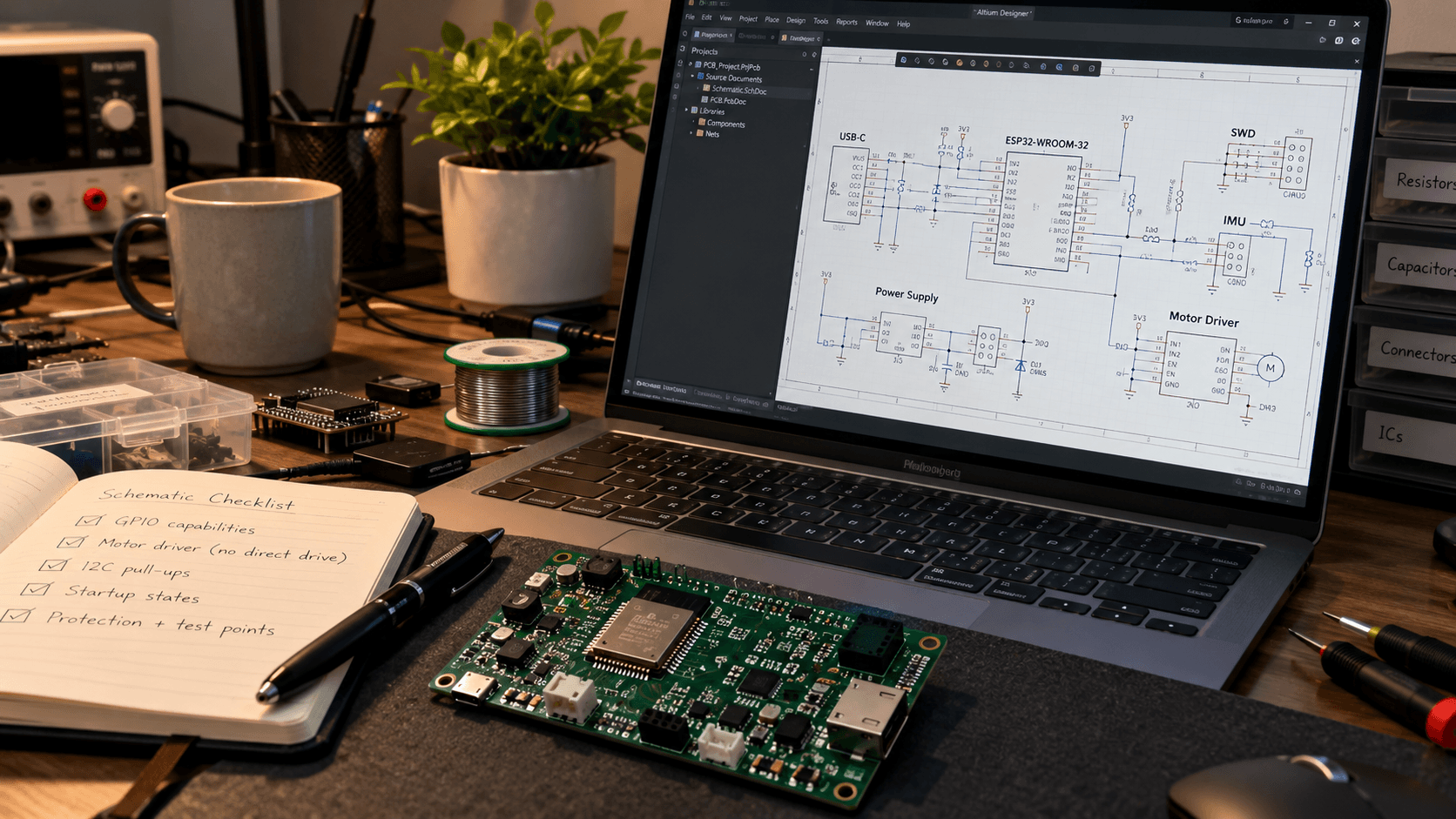
5 Schematic Design Rules I Always Check Before Making a PCB
When designing a custom PCB, it's easy to focus on component selection, circuit connections, and PCB layout. However, small mistakes in a schematic can lead to hours of debugging or even a completely non-functional board.
While working with microcontrollers, sensors, motor drivers, and custom PCBs, I've realized that checking a few important details before manufacturing can prevent many common hardware problems.
Here are five schematic design rules I consider essential.
1. Always Check GPIO Pin Capabilities
Not every microcontroller pin supports every function. Some pins are input-only, some have restrictions on ADC operation, and others affect the boot process.
For example, certain ESP32 ADC channels have limitations when Wi-Fi is enabled. Assigning a pin without checking its capabilities can result in non-functional inputs, unavailable analog readings, or startup problems.
My approach: Before finalizing a schematic, I check the microcontroller datasheet and pin-function table to verify that every selected pin supports its intended function, whether it's ADC, PWM, UART, I²C, or an interrupt.
2. Never Drive Motors Directly From GPIO Pins
Microcontroller GPIO pins are designed for logic-level signals, not for supplying the current required by motors, relays, and solenoids.
Connecting these loads directly can damage the microcontroller. Inductive loads can also generate voltage spikes when switched off.
My approach: I use an appropriately rated motor driver, MOSFET, or transistor to control power-hungry loads. I also check current ratings, voltage limits, and the need for flyback or other transient protection.
This is especially important in robotics projects, where motor operation can affect the rest of the electronics.
3. Get I²C Pull-Up Resistors Right
I²C is widely used to connect sensors and displays, but incorrect pull-up resistors can cause communication problems.
Without suitable pull-ups, SDA and SCL may not reach valid logic-high levels quickly enough. On the other hand, multiple sensor modules may already contain pull-ups, making the combined resistance too low.